research and application
In this section, copy and visuals are highlighted, specifically inspiration from zines, books, art, posters and research. Below I am also exploring the application of research into the project and it's outcomes, such as typefaces, pictures, overlays, words and ideas. Please click on the images to zoom in or use the arrows on the sides to scroll through.
gallery visits and zine shops


Our visit to the Barbican was very insightful, especially seeing this culture from another perspective, very raw and candid reflecting a history that goes back centuries (pictures 1-6).
I specifically appreciated the beauty of patterns and the cultural objects, they reflected a sense of personality that I also wanted to incorporate in the zine.
The visit to Soho Magazine shops, The Anarchist Bookshop and Whitechapel Gallery also helped us see different perspective of experimentation with paper and copy (pictures 8-10). We were inspired by various magazines/zines from the shops, specifically the ones for women that were unfiltered and unpolished, such as some seen in the pictures 9,12.
Along with this, what also inspired me a lot was the postcards section, which I want to incorporate as part of this project, specifically because they mean so much to migrants and they can have such a personal feel to a reader/viewer.
The zines shops helped us gain a better vision of the project (pictures 13-15) and to understand what this would look like in real life.
Specifically the words from the magazine and books such as 'Diasporic Threads' by Dr Sharbreon Plummer and 'A Long Way From Home' by Christina Rose. These two zines specifically inspired me because they are close to our subject, but they also gave me another perspective on migration: that it can be beautifully portrayed, it's not only negative. From then on we started to take a more positive stance on it and based our zine on this.
Our visit to the V&A museum was inspiring and very impressive, when we went there the project was already in progress, and all ideas were in their final stage. This was helpful especially for the exhibition that followed, as we were able to see beautiful layouts, intricate visuals and ideas. This gave us more ideas and the starting point of coming up with the 3D red/blue coloured glasses (pictures 12-33).
What stood out to me in particular, were the visuals on page 27, where you can see through different colours and shapes. This inspired the project to be portrayed in contrasting ways. Moreover, the books on page 29 really stuck with me due to the different fonts and the way the authors expressed themselves. I was drawn to the mix of the visuals combined with the words, all of them visibly calculated to evoke consistency. I was inspired by a lovely book, seen on page 19 'Paradise Camp' by Yuki Kihara, as it outlined traditions of a culture I didn't know much about. The way the author spoke about their culture and it's gender roles made it very engaging, I appreciate the simplicity . I also loved the layout of the pages, although the images are bright and colourful, the type is very carefully considered in order to stand out as well. I found myself more drawn to certain pieces because of their simplicity. This made me realise that it is the key and that our zine will stand out through it's minimalism and that the contrasting colours this would create a deeper message.
research
The slides on the right show the research done during the winter break, specifically readings and research into types and waves in which it was explored before, by artists such as Ilya Zdanevich and Stephane Mallarme. From page 1-20, I am researching the mentioned typographers and their work. Moreover, after reading a few texts, I have combined some of my favourite ideas and quotes from them and placed them on the slides (p. 9-20).
Subsequently, I have also done some research into magazines and zines made by and for women, such as 'Hunger' or 'Wonderwoman'. It was useful to explore how these magazines used layouts, photos and type very differently from each other but to target the same broad audience: women.


After looking at the more polished version of the spectrum, I went into researching zines, specifically migrant ones and have come across a wonderful one called 'the other side of hope'. It describes itself as the home for migrants and poets, and I absolutely adore the way they combine poetry and text with immigrant stories. I looked into the zine, it's history, it's editions and it's poems, and placed some research on the slides. I was also interested to read what the public had to say, as the audience's opinion is very important and it is crucial they feel represented and heard through media like this. Because our zine targets a similar demographic, the intent was not to plagiarise but to take it as an example of the change that can be made. The reviews surprised me, their audience felt seen and heard, and my goal was to make a similar impact on society. I looked at the different types of poems they featured and the artistic texts written by migrants with various unheard stories. This inspired me because every story is different, every poem is unique but I feel seen and heard when reading it.
Using this as an example, I started writing my own texts and poems, which are featured in our zine, and have been very emotional for me to write, as I had to channel all my emotions and all my 'hatred' for being away from my home and family but also love for London and the opportunities it offers.
Through this zine, I also found out two splendid books 'Legend of Bread' by Ana Doina and 'Nostalgic For A Place Never Seen' by Bhaswati Ghosh. Ana Doina is a Romanian migrant that has lived through the Soviet Siberian Romania, and her book has affected me a lot, especially because this is my culture's history.
Along with this, Bhaswati's book has also been an intriguing read for me, specifically because of the splendid culture but similarity in a way of thinking. The collection of poems has taken me through different states, from laughter to sadness, reminding me that being away from home is exactly that. On one side it is liberating and freeing from any past regrets or places, but on the other, it always holds you back, due to missing home and various 'what ifs'.
inspiration and work researched
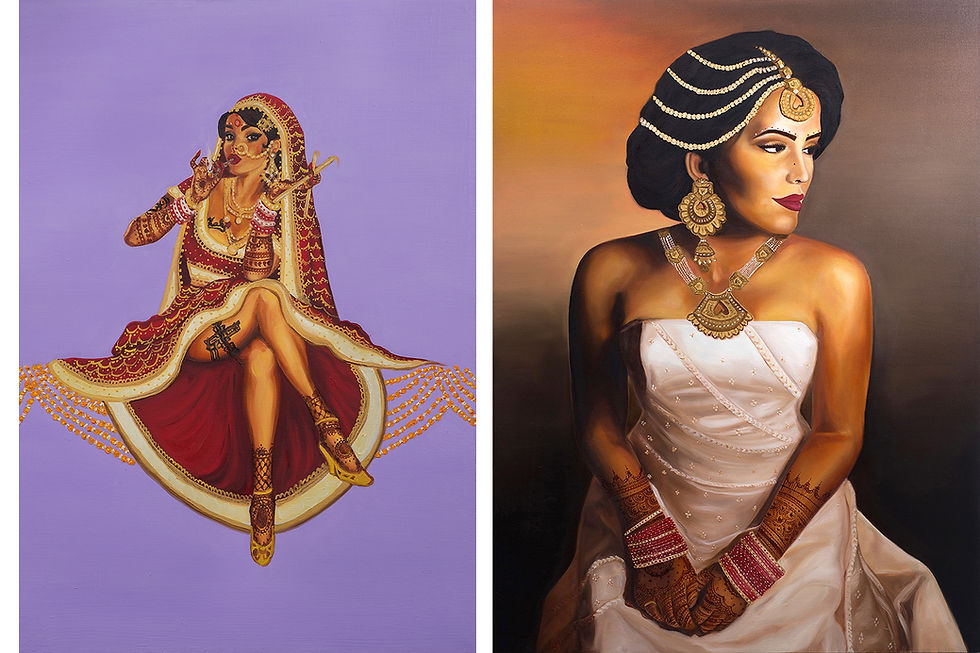
Nimisha Bhanot is a visual artist who explores themes related to women’s roles and empowerment from a socio-political side. She uses oil painting to challenge the male gaze, presenting an often-hidden female gaze from South Asian and North American cultures, aiming to destigmatise female stereotypes. According to her, the art work sends a message of influence to women to challenge and protest the status quo, empowering them through a unique approach of juxtaposing cultural symbols with liberating actions.
Her work inspired this project from the very start, due to her challenging and rough visuals. Both me and my creative partner wanted to incorporate this in our own project and support female migrants to cherish their culture but also to appreciate the new opportunities ahead. Her artworks are impressive and very close to our hearts as women and creators.



According to Monoskop (2023), Ilia Zdanevich was a Georgian-Polish and French writer, artist and publisher, and an active participant in such avant-garde movements as Futurism and Dada. Born in in Tbilisi, Ilia's contributions to the avant-garde movements were multifaceted, encompassing poetry, visual art, typography, and publishing. His approaches to design are inspiring, and he has had a crucial role in creating important international pieces. Today, his works are held in major collections, including the Museum of Modern Art in New York and the Fine Arts Museums of San Francisco.
Ilia's work has had a significant influence on the zine and my role throughout this project. What I like most about his work is using type as not only communication but also a striking visual. I admire his use of font and words as way to visually portray a message and I tried to incorporate this throughout the zine. This was done by strategically bending and swirling text to create a motion effect, or making letters seem like they are falling from sentences. This visually represents the feelings of a migrant when they are away from home, feeling like everything else is moving around them and that everything is 'falling' in or out of place.
Me and my co-creative worked together to create the visual effects, the type design and red and blue line drawings performing seamlessly in unison and evoking the same message and feeling: being unsettled.
As previously mentioned, the zine 'the other side of hope' had a significant impact on this project, due to their striking words, memorable texts and inspiring poems. Their work has influenced how I look at type for my own project, inspiring me to think of type as a took for expression and with attempting to write my own poems and text.
When doing research for this project it was very important to find other work and read the public's view on it, and as mentioned before, this zine is very well received, making readers feel seen and heard.
When reading this zine, I felt various kinds of feelings, but most of all I felt not alone, which inspired me and my co-creative to make work that has an influence on our own readers.


‘The Riot Grrrl’ is a zine collection that emerged in 1990 invented by women to fight against sexism in the punk industry. The idea of the zine came from a passionate group of women looking for a medium to be heard and fairly represented, which very quickly became an actual source for change for all women.
The approachable features of the zine played a part in its success, as women could utilise it to be listened to.
The raw yet empowering messages of the movement demonstrate that fighting for representation and change can be as simple as making a zine by hand, becoming a source inspiration for this project. I like the distinct visual language this zine collection is using and I think the tone of voice, copy and visuals all blend together communicating a need to change but also enforcing that change comes from action and each one of us.
Although our project has a unique tone of voice, I admire the bravery of the Riot Grrrl zine, and want to incorporate the same boldness in my own projects and copy.
‘A Letter Home’ by Hisham Rifai & Ayman Makarem is a zine me and my co-creative found in the zine and book shop 'Anarchist' in Whitechapel.
Both my co-creative and I bought this zine, due to being so impressed by it's message and striking visuals. This zine is an homage to the author's home and family after moving away from their country.
Although our project has a more broad perspective of migration, this zine's emotional depth was an inspiration for this project, specifically it's front cover and imagery.
Even though the zine feels like a love letter to home, it relates feelings of deep regret and sadness, which often is the story of many migrants. Through their consistency, even the zine’s visuals and copy relate this hopelessness and homesickness, making readers feel every single word deeply
I particularly admire the outline of this zine and the simple formatting, so when making our zine I wanted to incorporate this simplicity. I like the idea of the blank spaces and emotive drawings, which is exactly how our zine ended up.
On the right, I have also placed some other zine formats and examples, all of which impressed me and affected my choices during this project. I love the accessibility of zines, their approachability and personal feel of them. I admire the fact that you can tell a human made them, especially in such a digital world.
I like the handwritten aspect of zines, and the cut out pictures as well. In my opinion this adds to the personality of it, making it stand out in comparison to other magazines. All the details added such as cut outs, lines, icons and drawings add a lot of the author into the publication and it also helps reach the right target audience, that will enjoy, read and like the zine.


A piece of work that inspired us a lot is 'The Woven Chronicles' by Reena Saini, who is an Indian visual artist. As described by the artist: 'The work was conceived with electric wires to form a drawing that will trace migration patterns globally, where multitude of actors interact without knowledge of the overall situation'.
Her work is inspiring due to its original way to portray movement and migration. I really admire this work as indirectly inspired us to go for the line drawing technique in the zine, a drawing technique that uses lines to create an image, usually against a plain background.
This adds more personality and ambiguity to the zine, in my opinion. Moreover, it fits perfectly with the red and blue, s more symbols and motifs can be drawn intertwining.
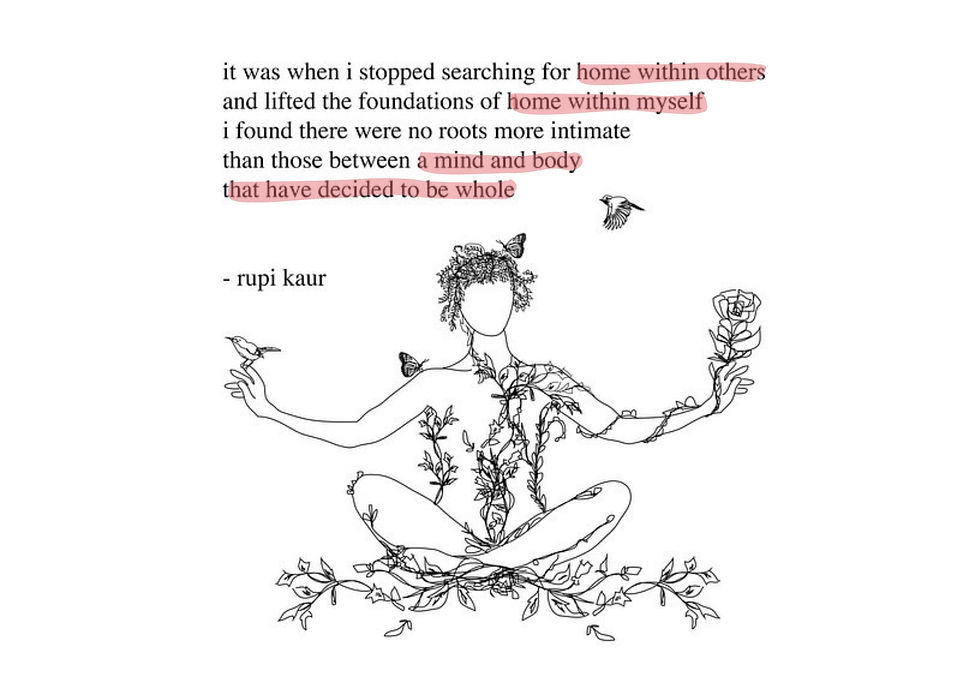
Rupi Kaur is a worldwide bestselling writer and the author of 'milk and honey', 'the sun and her flowers' and ‘home body’. I have adored some of her poems since a young age due to the simplicity of her writing and the relatability of her poems, especially for women. While working on this project I purchased all her books and indulged in her poetry for the first time. Her writing stuck with me and I look up to the style a lot, on the right you can see some of my favourite poems of hers, which have been highlighted and used as inspiration for the liberating style of her poems.
I particularly like the lack of rhyme and the her figures of speech. I have never written poems before, but for this project I have been very inspired, with a lot to say. I wrote a poem called 'dear home...' which uses repetition and coupled rhyme.


'Pillow Thoughts' by Courtney Peppernell is a book about heartbreak, heart ache and deep thoughts. It is a collection of poetry, with dividers for readers to open and find an exact emotion in the book. In my opinion, this is a beautiful read and I really like how the book is separated by section, in my opinion this adds to the poems.
Although I didn't expect it, this has been a great and mature outlook on pain and heartbreak, but also voicing feeglins and thoughts we don't regularly want to say. On the side there are a few of my favourite poems or texts, that I have taken something from for my own project, which is freedom to express whatever I want.
Whether it is to make the readers cry or laugh, I learned that I need to focus on the simple expressions and not to overcomplicate it, as this makes it difficult to read, while her poems are very easy and accessible.
Ana Doina grew up in Communist Romania, under the shadow of the Holocaust, WW2, the Iron Curtain and the Bomb so her life was shaped by the search for political and individual freedom. Although she left Romania due to the political and social factors at the time, her poetry serves as witness to the events that happened during that time, and the scar those years served on her home and culture. The soviet system, hunger and Siberian deportations have left scars on the country, due to being forced to destroy their culture, from incorporating Russian letters into their alphabet to taking lands and provisions.
Through 'Legend of Bread', Ana reaches out to us as a reader, encouraging us not to forget the past.
The author also tries to express her further experiences as a Romanian migrant in America, and 'foster a dialog with those trying to understand the experience of exiles, political refugees, emigrants; and with the children of immigrants living with the consequences of the history that gave birth to this story', according to the author.
This book has helped me a lot throughout this project, due to the feelings I felt when reading it. It reminded me of my culture's past, and that this is the reason my country is still recovering financially. These poems made me nostalgic, scared, but also angry for my ancestors and my homeland. This then helped me write down my ideas more clearly, about my experience as a Moldovan migrant. I therefore channeled my feelings when writing my texts, and it's helped me a lot with the visual side as well.


The poem 'Presents From My Aunts in Pakistan' by Moniza Alvi is autobiographical and it explores themes of cultural hybridity, focusing on the feelings of a teenage girl caught between cultures. Her father Pakistani and her mother is English, so the poem reflects a struggle those with dual heritage face, feeling not 'whole' for either culture. The girl in the poem feels broken between two worlds, and speaks about the cultural presents and motifs from her family with sadness, it is almost as if she doesn't see herself as them, but as an outsider.
She wants to be part of it and feels attracted to Pakistan, but at the same time feels overwhelmed by it. When she tries their national wear 'the costume', she does not feel confident and empowered, quite the opposite she is almost ashamed. This, however, is only a battle inside of herself, which is caused by overthinking the two cultures.
This poem is amazing, and it inspired my writing a lot, because it is raw and emotive. It focuses on her very unfiltered thoughts and I did the same with my poems and texts, as in my opinion this connects with the readers on a deeper level. I find the fual culture struggle interesting to write with, which is very similar to the topic of our zine, so I found myself re-reading this poem a lot.
'Migration Letters' by M. Nzadi Keita is a book that according to the author strives to tell a story about Black people that radiates across generations. The poems interrogate how one's present begins in the past, highlighting and appreciating history because it happened.
Throughout the poems, the book combines personal narratives with broader historical contexts to explore identity and belonging, showing that 'creating a home creates in ourselves'.
The author's writing is descriptive, with sensory details that transport you to the place and time in the poem. This helps the reader get involved into the poem, and I particularly tried to incorporate this on some level into my own text, such as retellings or diary entries within the zine.
I would love to learn to describe something as well as the author in her poems, as I feel like it adds a lot to the text, and it engages the reader on a personal level, just like she did while I was reading her poems.


'The Mara Crossing' by Ruth Padelis is a collection of poetry and prose that explores the theme of migration, both human and animal, across various contexts, including history, culture, and the natural world.
It discusses why animals migrate, as well as humans, and the texts have a clever way of combining and comparing the two.
According to the author: 'Mara, in the title, is the name of a river in Kenya, which zebra and wildebeest cross at the end of their three-month migration. It’s not that wide, you can splash through in a few minutes, but it’s full of the biggest and hungriest crocodiles in Africa.'
The text is inspiring to me for this project because of the writing style, I admire the texts and their way of keeping the readers engaged through the flawless combination of poem and prose, and how unconventional the copy is at times. I strive to combine the copy in my own zine the same way, making it all consistent.
further readings
As part of the development for my Advanced Project, I engaged with a range of books/texts that helped throughout the creative process as well as when writing the report. The readings helped me gain deeper insights into migration, identity, women's perspectives, immigration and so on. This knowledge helped build a steady foundation for the project, with a better understanding of my project and the messages from it.
All the readings helped me be critical of my own work and challenge my creativity, and below is a reflection of what each of the texts listed on the right slideshow has taught or influenced specific parts of my project:
-
According to Clark (1986), although it is not always possible to draw a definitive distinction between moves and migrating factors, one component of neighbourhood characteristics is accessibility (to workplaces, relatives or friends), which are concerns often expressed by moving households. In terms of economic characteristics, factors such as location, employment or changes in marital status or household size often cause relocation. - Has given me a topic of discussion for my report, reasons for migration. I was also intrigued by this to explore the deeper causes, not just surface level, which is violence, specifically for women (further discussed in my report).
-
'According to Verbuč (2024), zines are considered creative, expressive, and informative vehicles of connection that perform important social roles.' - His text has made me realise that zines affect people emotionally and provoke reactions, whether close or distant. One may think they consist of prints and pictures, but in reality zines come to life through the reader, especially those who relate to and feel the ideas within. They are far more personal than one may think, which I had no idea about before reading his text and therefore explored further in my report.


-
According to Barrett and Bolt (2007), interviews are a great way to gain qualitative information by understanding a person and their answers - this helped me realise that the human interaction between the interviewer and interviewee is crucial when gathering data. For our project, this was the most suitable research method as the process of interviewing can affect the results of the research and the creative process in general. So when having our interviews with Anastasia and Zofie, we needed to pay close attention to atmosphere, intonation and questions.
-
Chitac’s study of female Romanian migrants who have moved to the UK in hopes of finding new opportunities has found that they often diminish their identities to conform to socio-cultural norms prevalent in both their host and native countries (2023). This read offered me a new perspective: in some countries, especially post-Soviet and developing nations, women are still openly oppressed and regarded as inferior to men. This is why some move away from home, in hopes of escaping this treatment and building a life on their own, away from their oppressor, often times taking their kids with them.
-
Nawyn's Gender and Migration (2010) study influenced my work and report very much, due to the valuable insights reflected. According to the author, many migrants leave their homes in search of better economic opportunities, but at the same time, she argues that feminist migration scholars have discovered that the male explanations of economic migration do not apply to women. This opened my eyes to migration statistics. Our project focuses on migrant women, but due to studies being focused on men, can we really apply this to women? (further discussed in my report).
-
Kempson (2015) argues that zines represent a cultural movement that allows young girls to construct identities, communities, and explanatory narratives - this helped me picture zines as not just a way to escape or be understood. They have a bigger impact than that, which means that each zine needs to educate, influence and impact in a positive way.
-
Guzzetti and Gamboa (2004) describe zines as an act of civil disobedience, a tool activism, and a medium through which girls make changes within themselves - this shows a zine's effects of resistance against discrimination or misrepresentation, and it is what inspired our zine to fight towards it.
-
According to Vieira (2013) women already take on the triple shift: professional, family, and educational tasks. This then let me to the conclusion that the position of migrant women becomes even more complex due to this. Along with the triple shift, they need to manage education, work qualifications, language skills, adaptation to a new culture, and motherhood.
-
According to Davidson (2002), in her article women are rejecting patriarchal restrictive modes of writing and are pursuing autobiographical, bricolage style writing and creating, such as zines. This helped me link her ideas with another feminist's text and reach the conclusion that zines are used by women to express themselves and their frustrations against patriarchy.
-
Shin (2022) explores how foreign wives in Korea present themselves in relation to the dominant discourse surrounding them through stories of migration and marriage experiences. It was insightful to see how migrant women are represented in a country like South Korea, specifically because according to this text, they are often stereotypically associated with low social class and welfare dependency only because of being foreign.
-
Beazer's (2025) research examines how migrant women were represented in British and German news during the COVID-19 pandemic. The text compared how migrant women, including those from ethnic minorities, were covered in news articles from 2020-2021 and found that most times they were represented it linked to poverty, class and insecurity. Although represented, these outlets are least likely to lead to change due to the negative connotations.
-
Lovin's (2019) feminist paper on educational equality for migrant women helps link migration and education. The author challenges the idea that specifically Western countries are fair to migrants, who can succeed through fair hard work. This helped me see a different perspective to how migrants are treated, even if indirectly, their struggles are deeper and more complex than I thought.
